From Audience Question to Published Column | Arnon Grunberg NYC
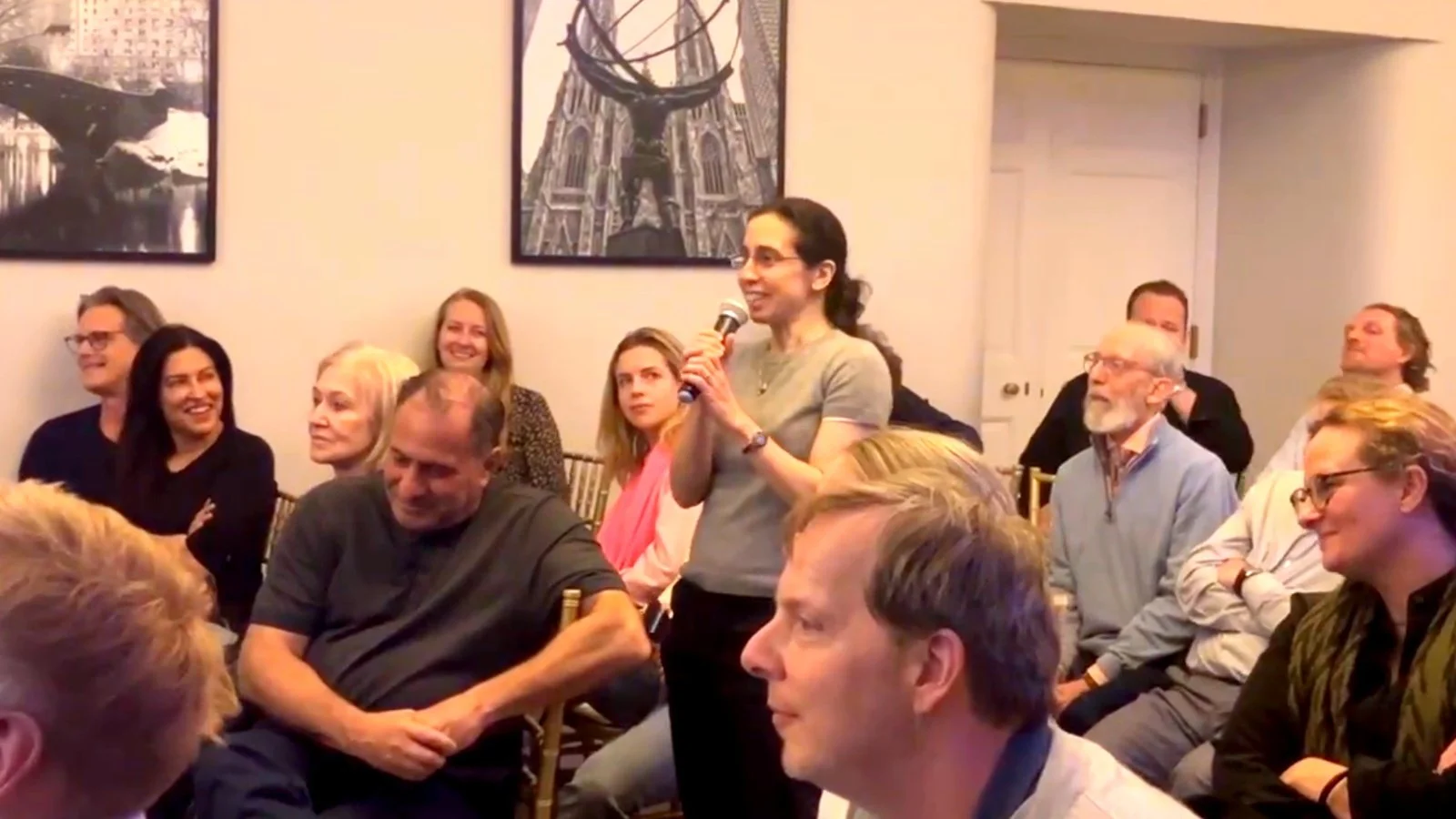
Julie Meerschwam puts Arnon Grunberg in the hot seat.
When a Fan Letter Becomes a Novel — and a Novel Becomes a Question
At our March 26 Book Club evening with Arnon Grunberg, the best moment wasn't planned.
Near the end of the night, Julie Meerschwam stood up. She told Grunberg that at 17, growing up in the same Amsterdam community, she had written him a fan letter. He never replied. She didn't hold it against him.
But three years later, Grunberg published his second novel, Figuranten. Reading it, Julie stopped cold. There was her surname — her rare, unusual surname — in the title of a chapter. Attached to a character described as an old, smelly, grumbling housekeeper.
Watch on YouTube \ Read de Volkskrant article below
For 28 years, Julie told him, the only time her name had ever appeared in print was as that woman.
Grunberg's response was immediate, honest, and a little Freudian. He didn't remember the letter. He didn't remember Julie. But he did remember the name — and traced it back not to any fan mail, but to stories his late mother used to tell about a certain mevrouw Meerschwam. Whether Julie's letter had lodged somewhere in his unconscious and surfaced just three years later in his fiction, he couldn't say. He was open to the possibility.
“There is an unconscious level and I’m enough of a Freudian to take the unconscious level quite seriously.”
He explained his usual method: obituaries. Take a first name from one, a surname from another. That's how most of his characters get their names. But Meerschwam was different. Meerschwam came from somewhere else.
The exchange lasted four minutes. It touched on memory, craft, the unconscious, and what it means to unknowingly carry someone's name into a story. Grunberg closed it simply: "I'm so glad you came here to tell me this. The beginning of a new book."
The next day, he wrote about it in de Volkskrant.
He explained his usual method: obituaries. Take a first name from one, a surname from another. That's how most of his characters get their names. But Meerschwam was different. Meerschwam came from somewhere else.
The exchange lasted four minutes. It touched on memory, craft, the unconscious, and what it means to unknowingly carry someone's name into a story. Grunberg closed it simply: "I'm so glad you came here to tell me this. The beginning of a new book."
The next day, he wrote about it in de Volkskrant.
Watch the four-minute exchange on YouTube.
Read de Volkskrant article below in Dutch and English.
This event was realized in partnership with the Consulate General of the Netherlands in New York and Dutch Culture USA with special thanks to Katherine Vos van Liempt and organizing team: Eveline Honig van Veldhuisen, Pauline Genee, and Marijke Zwikker-Stern.
The full 90-minute conversation with Arnon Grunberg — covering his work, his writing life, and much more — will be available exclusively on the HUB, our new members-only online community, in the coming days. Members and subscribers will receive an email with everything you need to join.

Hoe kom je aan namen voor personages in je roman? Overlijdensadvertenties
Arnon Grunberg — 31 maart 2026
Op het einde van een literaire avond in New York – het gesprek ging over een van mijn laatste romans maar de president van de Verenigde Staten kwam ook ter sprake, wat is een gesprek zonder hem? – stond een vrouw op. 'Ik heb nog één vraag', zei ze, 'misschien is het geen vraag.'
Ze zei dat ze jaren geleden, toen ze 17 was en in Amsterdam woonde, mij een fanbrief had geschreven, waarop ze nooit iets had gehoord. Later, toen ze nietsvermoedend mijn tweede roman begon te lezen, kwam ze haar zeldzame achternaam tegen. Die achternaam had ik verbonden, zei ze, aan een 'oude, stinkende, mopperende' hulp in de huishouding. Ze vroeg zich af of het niet tijd werd dat ik de 'aantrekkelijke, intelligente, getalenteerde, glamoureuze kleindochter' van die huishoudhulp in een boek zou opvoeren.
De achternaam in kwestie: Meerschwam.
De vraag was: hoe kom je aan namen voor personages? Ik gaf het antwoord dat ik vaker geef: overlijdensadvertenties. Je plukt een voornaam uit de ene overlijdensadvertentie, een achternaam uit de andere en voilà.
Maar mevrouw Meerschwam kwam als ik eerlijk was niet uit een overlijdensadvertentie.
Mijn moeder sprak indertijd veel over een zekere mevrouw Meerschwam, een hoogbejaarde mevrouw Meerschwam.
Na afloop gaf de jonge mevrouw Meerschwam, die inmiddels ook achter in de veertig was, me een brief waarin ik nogmaals werd opgeroepen van haar een getalenteerd, welriekend, intelligent en aantrekkelijk personage te maken. Er was geen strikte deadline, maar het was wel dringend.
Er werd met niets gedreigd, tussen de regels door echter werd mij duidelijk gemaakt dat het slecht met me zou aflopen als ik niet aan haar wens gehoor zou geven.
How do you come up with names for characters in your novel? Obituaries.
Arnon Grunberg — March 31, 2026
At the end of a literary evening in New York — the conversation was about one of my recent novels, though the President of the United States also came up, as what conversation is complete without him? — a woman stood up. "I have one more question," she said, "though perhaps it isn't a question."
She said that years ago, when she was 17 and living in Amsterdam, she had written me a fan letter, to which she had never received a reply. Later, while innocently beginning to read my second novel, she came across her rare surname. That surname, she said, I had attached to an "old, smelly, grumbling" housekeeper. She wondered whether it wasn't time for me to feature the "attractive, intelligent, talented, glamorous granddaughter" of that housekeeper in a book.
The surname in question: Meerschwam.
The question was: how do you come up with names for characters? I gave the answer I usually give: obituaries. You pick a first name from one obituary, a surname from another, and voilà.
But mevrouw Meerschwam, if I'm honest, did not come from an obituary.
My mother used to speak often about a certain mevrouw Meerschwam — a very elderly mevrouw Meerschwam.
Afterwards, the young mevrouw Meerschwam — who was herself now in her late forties — handed me a letter in which I was once again called upon to make her a talented, fragrant, intelligent and attractive character. There was no strict deadline, but it was urgent.
No explicit threats were made, yet reading between the lines it was made quite clear that things would not go well for me if I failed to honor her wish.